

Overview infographic of Realtek RTL8211F Gigabit Ethernet PHY family including RTL8211FS-CG, RTL8211FSI-CG, RTL8211FS-VS-CG, and RTL8211FSI-VS-CG with key shared features such as 10/100/1000 Mbps support, RGMII interface, and EEE low-power functions.
The selection of a Gigabit Ethernet PHY is crucial for networking equipment. Realtek offers highly popular, pin-compatible variants, leading engineers to compare options like RTL8211FS-CG vs RTL8211FSI-CG vs RTL8211FS-VS-CG vs RTL8211FSI-VS-CG. While all these chips share the same robust RTL8211F core—supporting 10/100/1000 Mbps speeds and RGMII/GMII interfaces—their differences lie in suitability for temperature and specific power-saving features.
Shared Excellence: The Core RTL8211F Platform
All four variants are built on the advanced RTL8211F platform from Realtek. This platform is known for providing high-performance, low-power physical layer functionality. Key shared features include:
-
Tri-Speed Support: Full compliance with 10BASE-T, 100BASE-TX, and 1000BASE-T Ethernet standards.
-
Energy Efficient Ethernet (EEE): Support for IEEE 802.3az, which significantly reduces power consumption during periods of low link utilization.
-
Integrated Functions: The PHYs integrate essential features like an LDO regulator and power-saving modes, simplifying board design and reducing external component count.
-
RGMII/GMII Interface: Standardized interfaces for connection to the MAC layer of a host processor or switch.
Key Differentiator 1: Commercial vs. Industrial Temperature
The most critical difference among the variants is the operating temperature range, indicated by the ‘I’ suffix:
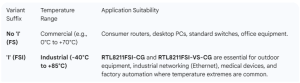
The RTL8211FSI-CG and RTL8211FSI-VS-CG are the default choice for rugged or non-climate-controlled environments.
Key Differentiator 2: The ‘VS’ Variant
The “-VS” suffix often indicates a specific die revision or a feature-optimized variant within the RTL8211F family. While detailed public datasheets vary, the “-VS” generally signifies an optimization related to power management or specific peripheral support:
-
Power Optimization: The “-VS” variants may offer enhanced power-saving features beyond standard EEE, or slightly lower power consumption in active mode, crucial for dense system designs.
-
Subtle Feature Set: Engineers working on new designs may specify the “-VS” variant to align with the latest silicon revisions, which may include bug fixes or minor performance tweaks not available in the standard “-FS” part.
For new projects, consulting the latest manufacturer application notes is always recommended. However, for most purposes, the RTL8211FS-CG and RTL8211FSI-CG are the baseline commercial and industrial parts, respectively, while the “-VS” parts are updated or power-optimized versions of those standards.
Choosing the Right Realtek Gigabit PHY
Selecting the correct PHY chip boils down to two questions:
-
Temperature: Does your product operate outside of standard room temperature (e.g., automotive or industrial use)? If yes, choose an ‘I’ variant (RTL8211FSI-CG or RTL8211FSI-VS-CG).
-
Revision/Optimization: Do you require the absolute latest silicon revision or specific power optimizations? If so, choose the RTL8211FS-VS-CG or RTL8211FSI-VS-CG version.
In the end, all four part numbers offer reliable, low-power Gigabit Ethernet connectivity. The distinction simply ensures your design is qualified for its intended environment and performance standard.