
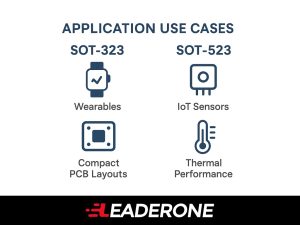
Infographic showing application differences between SOT-323 and SOT-523 packages for IoT, wearables, and compact electronics.
In modern electronics, space is often the most critical constraint. Engineers designing portable, wearable, and IoT devices rely on extremely small surface-mount technology (SMT) packages. The comparison between the SOT-323 vs SOT-523 package highlights a key decision point for designers. This involves balancing physical footprint against thermal performance and manufacturing complexity. These two packages are ubiquitous for housing small signal components.
SOT-323 vs SOT-523 Package: The Size and Space Trade-Off
The primary difference between these two packages is their physical size. The choice often comes down to how much board real estate the designer can afford to allocate.
| Feature | SOT-323 (SC-70) | SOT-523 (SC-75) |
| Typical Body Length | ~2.0 mm | ~1.6 mm |
| Typical Body Width | ~1.25 mm | ~0.8 mm |
| Footprint Area | Larger | Significantly Smaller |
| Thermal Performance | Generally Better | More Challenging |
The SOT-523 package offers a clear advantage in miniaturization. It takes up significantly less space on the Printed Circuit Board (PCB). This makes it the go-to package for wearables, smart tags, and disposable electronics where every millimeter counts. Conversely, the slightly larger SOT-323 package provides a larger thermal pad area. This can be essential for components handling moderate current loads or operating in higher ambient temperatures.
Design and Manufacturing Factors for the SOT-323 vs SOT-523 Package
Engineers must weigh several factors beyond just size when choosing between the SOT-323 vs SOT-523 package:
-
Thermal Management: The SOT-523 package has reduced thermal dissipation capability due to its minimal size. For components with a high power rating, the SOT-323 may offer a crucial margin of safety against overheating.
-
Manufacturing: The smaller size and tighter pitch of the SOT-523 require more precise placement equipment during manufacturing. While both are suitable for standard SMT processes, the SOT-523 demands tighter tolerances.
-
Component Availability: The SOT-323 is slightly older and often has broader component availability across different manufacturers. However, the SOT-523 has become standard for many newer, power-optimized discrete components.
Ultimately, both the SOT-323 and SOT-523 are essential tools in miniaturization. The SOT-323 provides a reliable, more thermally stable solution, while the SOT-523 pushes the boundaries for ultimate space saving in the smallest consumer devices.